Calculator
Enter your outdoor baseline, two indoor readings, and the time between them, with no fresh CO2 added during that interval. We suggest starting with two hours.
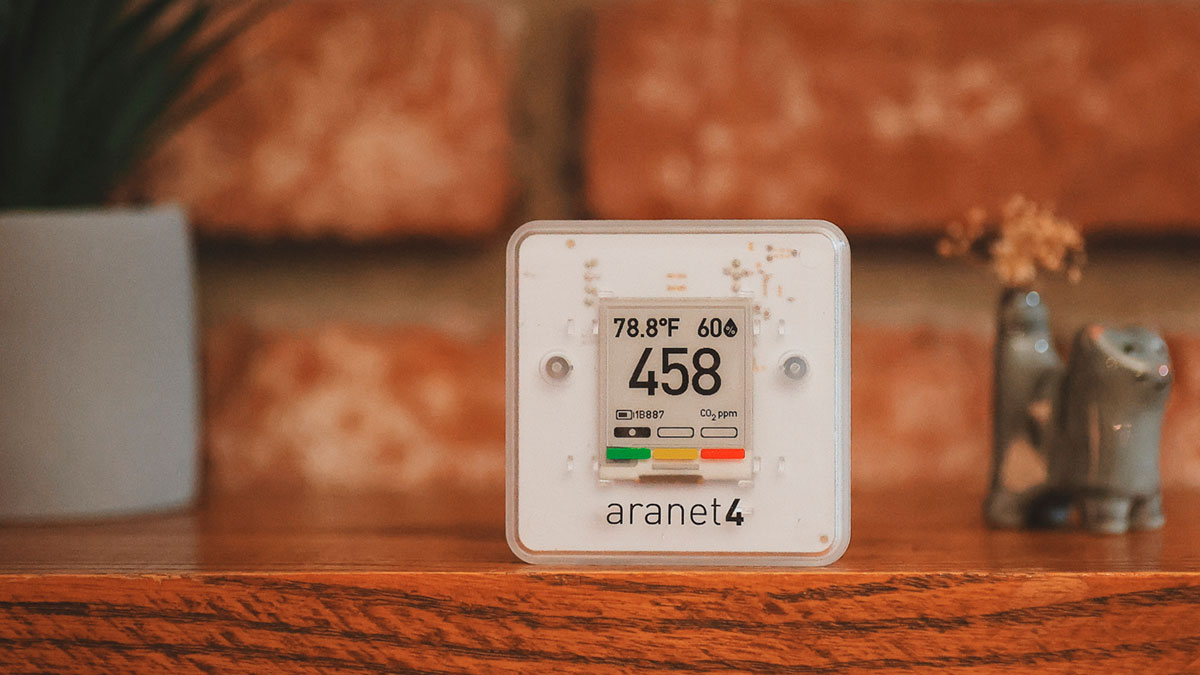
Take the meter outside; usually 400 to 450 ppm.
hours
minutes
The higher, earlier reading.
The lower, later reading.
0.35air changes / hour
Roughly one air change every 2 h 52 min.
ACH = (−1 / 3.00) × ln((870 − 578) / (1411 − 578)) = 0.35 /h
How to run the test
- Use an NDIR CO2 meter (the common desktop or handheld type).
- Take it outside for 5 minutes to read the outdoor baseline, then bring it back in.
- Get the room's CO2 well above baseline by doing light exercise such as jumping jacks or jogging in place, or just talking with a few friends in the same room.
- Stop adding CO2: everyone leaves, no candles or gas appliances. Record the start reading and the time.
- Wait about two hours before recording the end reading and time. You want a long enough window to see a clear drop, but the end reading should still be well above the outdoor baseline. If the room has already fallen back to baseline, use a shorter interval.
- Enter the two readings, the baseline, and the elapsed time above.
Mixing helps. Run a small fan in the room to keep the air well mixed, and keep the meter away from people, vents, and open windows, so it reads the room as a whole.
The math
The excess CO2 above the outdoor baseline decays exponentially as outside air dilutes it:
C(t) − C_baseline = (C_start − C_baseline) × e^(−ACH × t)
Solving for the air-change rate gives:
ACH = (−1 / t_hours) × ln( (C_end − C_baseline) / (C_start − C_baseline) )
where C_baseline is the outdoor CO2, C_start and C_end are the indoor
readings at the start and end of the period, and t_hours is the time between them. This is the
standard tracer-gas decay method (ASTM E741), with CO2 as the tracer.
The method, demonstrated
A clear walk-through of the CO2 decay test and this calculation.
Thanks to Al Haddrell for introducing this method.
What it tells you, and what it does not
- It measures air exchange with outside (natural leakage plus any mechanical ventilation), which dilutes CO2 and other pollutants. Higher ACH means more fresh air.
- It assumes a single, well-mixed room, a steady outdoor baseline, and no CO2 sources during the decay. Choose a window that shows a clear drop while the end reading stays well above the outdoor baseline.
- It does not count particle removal by a filter or air purifier. A purifier adds its own "equivalent" clean-air changes on top of this ventilation rate.
- This is a quick field estimate, not a certified blower-door or professional tracer-gas test.
The number you get here is the same quantity as the Room ventilation value in the builder's Advanced panel. Measuring your own room makes the builder's infection-risk estimate more accurate.